.jpg.jpeg)

.jpg)
 Search
.jpg "ebook")
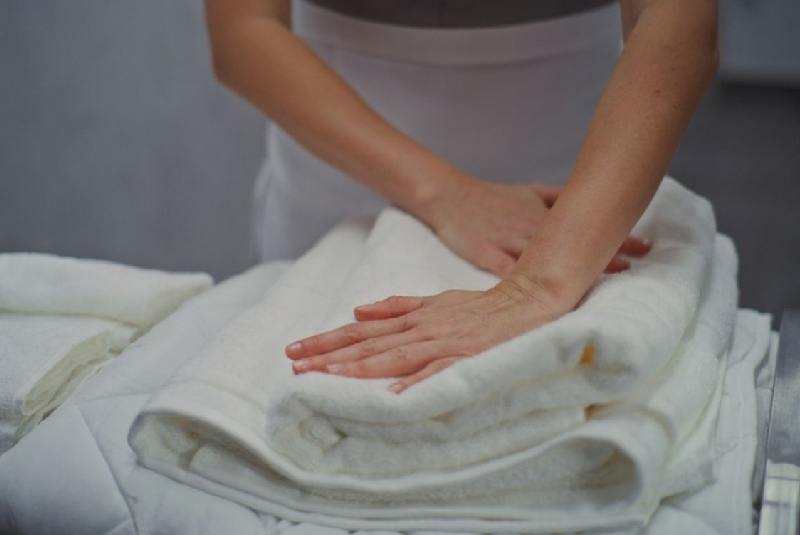
A towel has a surprisingly complicated life.
It begins as fibre, becomes a finished textile, travels to a hotel, passes through countless hands, is washed again and again, dried, folded, stored, used, collected and returned to the laundry. Eventually, it reaches a point where it is too worn, damaged or lost to continue.
Yet for much of the hospitality and laundry industry, the story of that towel remains largely invisible.
How many times was it washed? Where was it lost? What caused it to deteriorate? How much water and energy did it consume? How much chemical was used to clean it? And when it finally left the operation, where did it go?
These are no longer questions the industry can afford not to answer.
The future of linen management is moving beyond clean linen to intelligent linen — where digitalisation provides visibility across the lifecycle and sustainability turns that visibility into action.
 As Manoj Patankar, Sales Director, LA Laundry, puts it, “Digitalization gives us visibility, while sustainability gives us responsibility.”
That simple distinction may define the next generation of commercial laundry.
The Linen Lifecycle Needs A Rethink
Linen management has traditionally been a numbers game. How many sheets are in circulation? How many kilos are being processed? How many towels are missing?
But weight and volume tell only part of the story.
Today, the bigger question is: what is happening to every piece of linen throughout its useful life?
Digital technologies such as RFID, barcodes and automated inventory systems are beginning to answer that question. An RFID tag sewn into a towel or bedsheet can create a digital trail — recording movement, washes, circulation and, potentially, the point at which an item is removed from service.
 Narayanan Raghavan, Chief Executive Officer, Dr. Linen describes the significance of this shift in strikingly simple terms.
“A chip changes that. Every wash, every rejection, every time an item drops out of circulation can be recorded as it happens.”
Suddenly, linen is no longer an anonymous commodity moving through a laundry. It becomes an asset with a history. And that history can reveal a lot.
If one category of towel consistently fails after fewer washes than another, there is a question to investigate. If linen is disappearing between the hotel and laundry, there is a loss to identify. If a particular washing process is damaging fibres, there is an opportunity to intervene.
Data turns linen loss from a mystery into a management problem.
Sustainability Starts With Knowing What You Waste
There is a temptation to think of sustainable laundry simply in terms of consuming less: less water, less energy, fewer chemicals.
But the smarter approach is to ask whether those resources are being used correctly in the first place.
Commercial laundries are resource-intensive environments. Water, heat, electricity and chemicals are essential to delivering hygienically clean linen. The challenge is to optimise them without compromising cleanliness, productivity or textile quality.
That is where digitalisation becomes particularly powerful.
Automated chemical dosing, for example, can ensure that the quantity of detergent is matched to the actual load rather than relying on fixed quantities or manual estimation.
Optimised wash programmes can reduce water consumption. Heat recovery can capture energy that would otherwise be lost. Efficient drying systems can reduce unnecessary energy use.
And sometimes sustainability comes down to something as basic as knowing when to stop drying.
“Preventing over-drying linen can save energy while also extending linen life,” says Patankar. It is a small operational adjustment with a double benefit: lower energy consumption and fewer damaged textiles.
The Hidden Cost Of A Damaged Towel
Here is where the sustainability conversation gets interesting. The environmental cost of linen does not end when it leaves the laundry.
If a towel is damaged prematurely because of excessive chemical use, high temperatures, aggressive processing or poor handling, the hotel needs to replace it. That means another towel has to be manufactured, transported, processed and eventually washed. The most sustainable towel, therefore, may simply be the one that stays in circulation longer. This makes linen lifespan an important sustainability KPI — not just a procurement metric.
Patankar argues that operators should track indicators such as water and energy consumption per kilogram, chemical consumption, rewash rates, linen loss, rejection percentages, lifespan and processing costs.
The principle is straightforward:
Measure first. Improve second.
Without data, sustainability remains an aspiration. With data, it becomes operational.
From Smart Machines To Smart Decisions
The intelligence is not limited to the linen itself.
Laundry equipment is becoming smarter too.
IoT-enabled machinery can monitor performance and identify unusual behaviour before it develops into a major breakdown. Predictive maintenance can alert operators to potential problems before a washing machine, dryer or ironer fails.
That matters because a machine that is not performing efficiently can quietly waste resources long before anyone notices.
Then there is smart dosing, where the chemical requirement is determined by the actual load rather than a standard formula.
Raghavan points to a broader transformation taking place across the industry.
“Things that used to rely on instinct can now be measured, wash by wash.”
That is perhaps the real promise of digitalisation.
It does not necessarily replace human expertise. It makes that expertise more informed.
Giving Textile Waste A Second Life
The sustainability story becomes even more compelling when linen finally reaches the end of its useful life.
For too long, worn-out textiles have been treated as an endpoint.
Raghavan's work at Dr. Linen and 360 Weave is built around a different premise: that textile waste is not necessarily waste at all.
“Waste is just material for which we haven’t yet built the right system.”
Consider the humble hotel towel.
Once it is no longer suitable for a guest room, it could be discarded. But it may still contain valuable fibres that can be recovered and used in another product.
Through fibre extraction and recycling, the objective becomes life extension rather than disposal.
But this circular model has one major requirement: proof.
It is increasingly not enough for an organisation to say that it collects and recycles textile waste.
The industry needs to know what happened next.
Where was the textile collected? How was it sorted? Where was it processed? What material was recovered? What did it become?
This is where digitalisation becomes the bridge between a sustainability claim and a sustainability record.
Enter The Digital Product Passport
The emerging Digital Product Passport could take this idea even further.
A DPP is designed to carry information about a product throughout its lifecycle — from composition and origin to environmental information and, ultimately, reuse or recycling.
For linen, the implications could be significant.
Imagine a future where the lifecycle of a hotel sheet is no longer a black box.
Its material composition is known. Its use can be tracked. Its wash history can be recorded. Its lifespan can be measured. And when it is finally retired, its next destination can be documented.
Raghavan believes this is where RFID and DPP technology become closely connected.
“If you can't trace something, can you really say you're managing it?”
It is a powerful challenge to an industry that has sometimes relied on broad sustainability statements rather than detailed evidence.
The future is likely to demand something different:
Don't just tell us that it is sustainable. Show us.
The Circular Laundry Is Coming
This shift could fundamentally change how hotels think about linen.
Today, procurement often focuses on price, quality and durability. Tomorrow, lifecycle data could become equally important.
Hotels may increasingly ask:
- How many washes can this textile realistically achieve?
- What is its resource footprint?
- Can its performance be tracked?
- Can it be repaired or reused?
- Can its fibres be recovered?
- Can its journey be documented?
The result could be a move from a linear linen economy — buy, use, wash, discard — towards a circular model where every stage is measured and every possible extension of life is explored.
The Human Factor Still Matters
For all the excitement around RFID, IoT, smart machines and digital passports, technology alone will not make a laundry sustainable.
People will.
The technology can identify that water consumption has increased. Someone still needs to investigate why.
The system can flag excessive chemical usage. Someone must act on it.
Data can reveal that linen lifespan is falling. Operators must change the process.
For Raghavan, sustainability ultimately comes down to discipline.
“It should become a way of life: how we use our resources mindfully, how we avoid waste and how we practice discipline even when nobody is watching.”
That is an important reminder as sustainability becomes increasingly digitised.
A dashboard does not create sustainability. The decisions made because of the dashboard do.
From Clean Linen To Intelligent Linen
The laundry industry has spent decades becoming faster and more efficient.
The next challenge is becoming smarter.
The goal is no longer simply to process more kilos of linen per hour. It is to understand the journey behind every kilo — and reduce the resources, waste and unnecessary replacement embedded within it.
Digitalisation can tell us where linen goes, how it performs and where inefficiencies exist.
Sustainability tells us what to do with that information.
For Patankar, the destination is a laundry where every resource is used deliberately.
“Every litre of water, every unit of energy, every chemical dose and every piece of linen is managed with purpose.”
That may be the defining principle of the next era of commercial laundry.
Because the future of linen will not simply be cleaner.
It will be smarter, traceable and circular.
And perhaps the biggest transformation will be that the humble hotel towel will no longer disappear into the laundry system without a story.
It will have a history.
And, increasingly, the industry will have the data to prove it.
