


 Search
.jpg "ebook")
Are you feeling the impact of the shipping disruptions that have reshaped the Gulf since March 2026?
From manufacturers and distributors to facility management providers and hospitality operators, almost every business that relies on imported equipment, chemicals or spare parts has been grappling with the consequences. Delayed shipments, rising freight rates and unpredictable transit times have become part of everyday conversations.
For ALBARIQ Equipment, however, the disruption was never just a headline. It was a scenario the company had prepared for years in advance, and was ready to manage.
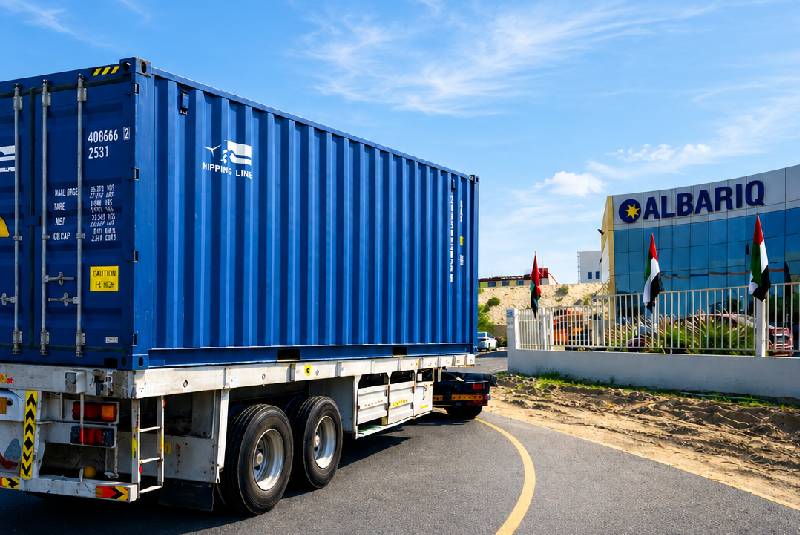
For six weeks earlier this year, not a single container reached the company’s UAE facility. Sixteen containers were stranded simultaneously across ports in Oman, India, Pakistan and Africa — cargo that, under normal circumstances, would have cleared within days. It was perhaps the clearest expression of a logistics crisis that has transformed trade patterns throughout the Gulf since the closure of the Strait of Hormuz in early March 2026.
Commercial traffic through the Strait has dropped by more than 90%. Khor Fakkan and Fujairah Ports have been forced to absorb diverted volumes from across the region. Shipments that once took three weeks to travel from Italy to Dubai are now taking considerably longer and at a considerably higher cost.
For companies that depend on the timely arrival of capital equipment and critical spare parts, the question is no longer whether delays will happen. The question is what happens when sixteen container shipments are delayed simultaneously.
ALBARIQ Equipment, the region’s leading supplier of professional cleaning and floor-preparation machinery, has spent the past months answering exactly that question. And the answer reveals a fundamental truth: resilience is not created during a crisis. It is built years before one arrives.
The Cost of a Container in 2026
The financial impact of the disruption has been severe and uneven. Across recent ALBARIQ shipments, freight costs for a standard 40-foot container from Europe or Asia to Dubai have ranged from roughly double the historical norm to more than eight times higher, depending on the route, port congestion and the number of times cargo has been re-handled.
ALBARIQ’s response to supply chain disruptions delivers a powerful lesson: resilience is not something improvised during a crisis; it is built through years of planning, financial discipline, strong partnerships, and continuous investment in people, processes, and, in this scenario, inventory itself. By anticipating risks, diversifying supply networks, and maintaining agility across its operations, ALBARIQ was able to navigate global challenges while continuing to serve its customers with minimal disruption.
Before the crisis, a container typically cost between AED 10,000 and AED 12,000. Today, a “normal” shipment often clears at AED 35,000 to AED 45,000 once war-risk surcharges, inland transportation charges and additional handling fees are accounted for. In worst-case scenarios, detention costs, transshipment expenses and repeated handling across intermediate ports have pushed the total above AED 112,000 for a single container.
Such extraordinary costs cannot realistically be passed on to customers. They have to be largely absorbed so that customer deliveries can continue despite the delays and additional costs.
Three Years of Preparation, Not Three Weeks
ALBARIQ’s response to the Strait of Hormuz disruption wasn’t built overnight. In many ways, it began during the Red Sea crisis of 2024. Those events highlighted a reality many supply chains had ignored for years: efficiency and resilience are not always the same thing.
Rather than pursuing increasingly lean inventory models and optimising purely for working capital, ALBARIQ deliberately chose a different path. The company invested in inventory, strengthened logistics flexibility and accepted the additional cost that comes with preparedness. It was a calculated decision.
Maintaining higher inventory levels is expensive. Warehousing costs increase, capital remains tied up, and traditional financial thinking often favours reducing stock wherever possible. But ALBARIQ chose resilience over optimisation. That decision is paying dividends today. Even as freight costs have surged to eight times historical levels and containers remain stranded for weeks, the company has avoided major disruptions to customer deliveries.
There Is No Substitute for Inventory
Perhaps the most important lesson from the current crisis is a simple one: there is no substitute for inventory.
Maintaining high stock levels has long been part of ALBARIQ’s operating philosophy. Rather than viewing inventory as a burden, the company has treated it as insurance. Today, its planning system manages 26,350 planning items and approximately 15,000 active part numbers, and spare parts alone account for between 25 and 30 percent of total inventory value — a level significantly higher than what is typical in the industry.
That commitment reflects an understanding of the sectors ALBARIQ serves. When a floor scrubber, sweeper or industrial machine breaks down, customers cannot afford to wait weeks or months for replacement components. Hospitals, airports, hotels and facilities continue to operate regardless of geopolitical events. Daily air shipments continue replenishing inventory even when sea freight slows or stops.
Inventory may not be glamorous, but in times of uncertainty it becomes one of the strongest competitive advantages a company can possess.
AI That Delivers Real Business Value
Artificial intelligence has become one of the most discussed topics in business. But for ALBARIQ, AI stopped being a buzzword more than two years ago. Since April 2024, all inventory planning and purchasing activities have been supported by an AI-driven demandplanning platform.
Unlike traditional forecasting systems, the platform continuously analyses demand patterns and generates automated purchasing recommendations across thousands of SKUs. More importantly, it dynamically adjusts safety-stock levels, purchasing frequencies and service targets as conditions evolve, allowing the system to react to disruptions in real time rather than relying on fixed assumptions.
Two years after implementation, the platform remains ALBARIQ’s most successful AI initiative, and arguably the one most directly responsible for helping the business navigate today’s supplychain challenges.
In a world where conditions can change weekly, AI has become less about automation and more about adaptability. The ability to continuously recalculate inventory requirements across more than 26,000 planning items gives the company a level of agility that would be impossible to achieve manually.
Visibility Matters
Supply chains cannot be managed effectively without visibility. Every inbound container heading to Dubai, Jeddah, Dammam and Doha is tracked in real time through a platform integrated directly with ALBARIQ’s ERP system. Whether a vessel reroutes around the Cape of Good Hope, waits offshore for clearance or gets offloaded midway through its journey, the planning team sees it immediately.
This visibility allows sales teams to provide realistic delivery commitments based on actual conditions rather than optimistic carrier schedules. Customers may not always welcome delays, but transparency creates trust, and that trust becomes especially valuable during uncertain times.
Logistics Flexibility Creates Options
Another major advantage lies in ALBARIQ’s regional footprint. The company operates seven stocking locations across Dubai, Abu Dhabi, Riyadh, Jeddah, Dammam, Tabuk (NEOM) and Doha, with every SKU visible in real time through Microsoft Dynamics 365 Business Central. If inventory becomes scarce in one location, stock can be transferred from another within days rather than waiting months for replenishment.
The same philosophy extends to inbound logistics. ALBARIQ’s presence in both Saudi Arabia and the UAE gives it access to multiple ports, including Khor Fakkan, Fujairah and Jeddah Port. Cargo originating from Asia generally enters through UAE ports, while European shipments arrive through Jeddah, so when one route experiences congestion, another remains available.
This dual-coast strategy provides something increasingly valuable in today’s environment: options. During the worst weeks of the current disruption, those options proved decisive.
Financial Strength Brings Stability
Perhaps one of ALBARIQ’s greatest strengths is one customers rarely see: the company operates with zero debt. This conservative financial approach has created the flexibility required to take on extraordinary costs without creating short-term cash-flow pressure.
When container costs climbed to more than AED 112,000, ALBARIQ did not need to react with panic or emergency measures. Instead, the company was able to absorb those costs, continue funding elevated inventory levels and maintain service continuity.
Financial resilience often receives less attention than technology or operations. Yet during times of crisis, balance-sheet strength becomes a strategic asset, and the ability to make decisions based on long-term priorities rather than short-term pressures allows companies to navigate uncertainty with greater confidence.

A Modern Operational Backbone
Supporting all these capabilities is a technology infrastructure built over several years. Microsoft Dynamics 365 Business Central provides operational visibility across the entire group, while Salesforce Field Service supports after-sales operations across the UAE, Saudi Arabia and Qatar.
QR-coded equipment, digital service workflows and 24-hour response standards represent the visible outcome of years of investment. Customers experience faster service and better communication, but behind the scenes those capabilities are powered by systems designed to improve responsiveness and resilience.
Resilience Is Built Before the Crisis
Supply-chain disruptions are unlikely to disappear. Geopolitical tensions, changing trade routes and increasing uncertainty suggest that volatility may become the new normal. For ALBARIQ, the events of 2026 have validated decisions made years earlier.
The lessons are straightforward.
- Inventory matters.
- Technology matters.
- Financial discipline matters.
- Logistics flexibility matters.
Most importantly, resilience cannot be purchased when a crisis begins. It must be built long before.
As businesses across the Gulf continue navigating one of the most challenging logistics environments in recent history, ALBARIQ’s experience offers an important reminder. Preparedness may not always be the cheapest strategy, but when uncertainty arrives, it is often the most valuable.
