


 Search
.jpg "ebook")
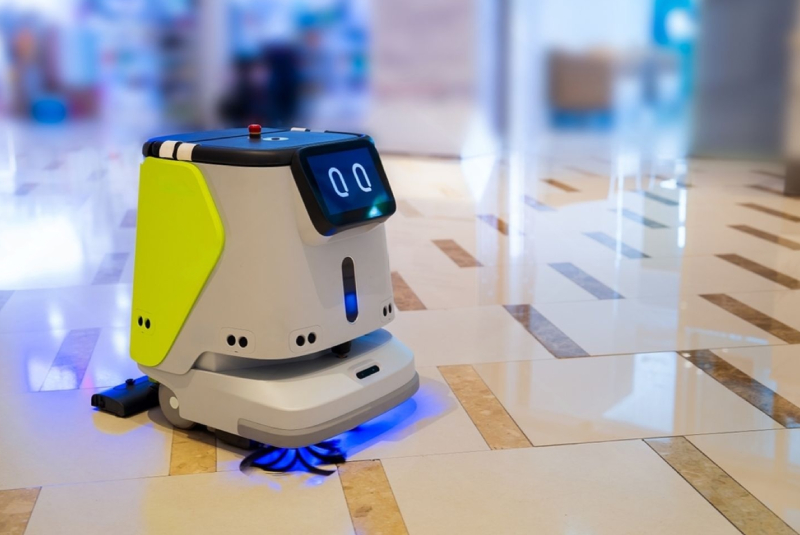
New technology is no longer an optional issue anymore in the FM industry, it has become a way of life for the facility managers making their work simpler, smarter, safer and sustainable. It is the tool which enables them to better understand their customers and their suppliers in order to build loyalty and commitment, to reach new previously unattainable markets, create new products and services, optimize processes, enhance human capital and manage risk rather than mitigating it.
And what we cannot ignore any more in the 21st century is that Al and Robotics are becoming a big part of this new technology by transforming traditional reactive approaches into smart proactive and data driven operations and by leading to better decision making and cost efficiency, supporting sustainability, managing waste and energy, improving safety and compliance and satisfying the user. It is shaping in a way or another the future of the FM industry.
But after all, every human innovation has upsides and downsides.
High upfront costs
AI powered systems and robotics require substantial upfront costs of hardware, software and integration which can be invested and implemented by big enterprises but for small and medium sized enterprises may find it difficult to justify the return on investment and to afford the cost of training and development in order to utilize it effectively. And beyond initial implementation costs, FM companies must also consider long term operational costs such as cloud storage fees, API access charges, periodic model retraining and security updates. Their recurring expenses can add up significantly, making it crucial to develop a cost-efficient Al adoption strategy.
Job loss for existing team members
Al and Robotics will replace some human roles in the FM industry especially the white collar and blue-collar jobs and this kind of transformation may let many employees and unions resist its adoption due to the fear of unemployment or distrust in this new technology. This integration may worsen societal imbalances or generate new ones across countries. By 2030, Al and Robotics may replace 800 million jobs globally, according to Mckinsey Global Institute research. Workers with lesser education and specialized skills sets may require assistance adapting to the changing employment market due to this displacement and the FM industry will be affected in a way or another from this socioeconomic inequality.
Lack of human touch
AI and Robotics will also shape the nature of human relationships with the limitedness or the lack of the face-to face interaction and the emotional, social and mental human interaction. After all, the FM industry is based on the principle of "people supporting people". And this kind of interaction needs emotional intelligence which is an important tool for strengthening leadership and improving decision making skills especially in the FM industry. That is, it equips Facility managers with self-awareness and empathy. They are also more in tune with their emotions, biases and stress triggers, which means they can make rational decisions based on objectivity rather than impulse.
Ethical considerations
Unfortunately, reports on the ethical and social concerns of Al and Robotics have been increased from 6% in 2019 to more than 40% in 2024 with a focus on the consequences of Al and Robotics if unregulated by governments and not assisted by policy makers in developing frameworks and policies. Moreover, without setting and implementing regulations, policies and frameworks will pose dangers from unintended disastrous and undesirable outcomes. Cyberattacks on critical infrastructure networks for example will pose grave threats in increasing the FM service breakdown.
Environmental and social considerations
Last but not least, FM companies cannot ignore any more issues of social responsibility or environmental concerns nor should they want to do so. Increasing government regulations and strong public mandates for social and environmental accountability have brought these issues into the executive suite and onto strategic planning agendas and the FM Companies are in the thick of the action. According to many studies, one of the environmental impacts of Al and Robotics ironically stems from how it accelerates the production process. The speed that Al and Robotics brings into production directly boosts the consumption of those goods by the masses. In the long-term increased consumption leads to planned obsolescence and depletion of natural resources and will pile on more waste products on a regular basis.
Also, the unprecedented demand for Al and Robotics in the FM industry is straining power grids and this means producing millions of tons of CO₂ emissions than it should be. Al and Robotics have a real energy appetite and as long as Al data centers are increasing, the electricity and water consumption will increase. A single Al training run like GPT3 emits around 284 tons of CO₂ which is equivalent to 700,000 km of a diesel car or electricity use of 60 households for a full year or 20-year CO₂ footprint of an average person.
About the author:
Nabil Bekdash is the Chief Operating Officer of Tanzifco Kuwait.
